



In modern society, skin condition and appearance are often viewed as a reflection of overall health and social status. The aesthetic dermatology market in Lithuania, as worldwide, has experienced rapid growth in recent decades, offering increasingly advanced methods to combat signs of skin aging, scars, and pigmentation disorders. Although daily care and cosmetic products are an important part of a routine, they often affect only the superficial layer of the skin (the epidermis) and fail to resolve deeper, structural issues, such as the loss of collagen fibers or deep atrophic scars.
To meet growing patient expectations and achieve long-term, clinically proven results, medical technology offered a solution: fractional laser skin resurfacing. This is one of the most modern and effective procedures designed for intensive skin restructuring. However, it is not a simple cosmetic manipulation, but a complex medical intervention requiring deep expertise, patient discipline, and realistic expectations. Before making a decision, it is necessary to analyze in detail what fractional laser is, how it works, and its advantages and potential risks.
The Principle of Fractional Resurfacing: Controlled Trauma for the Sake of Regeneration
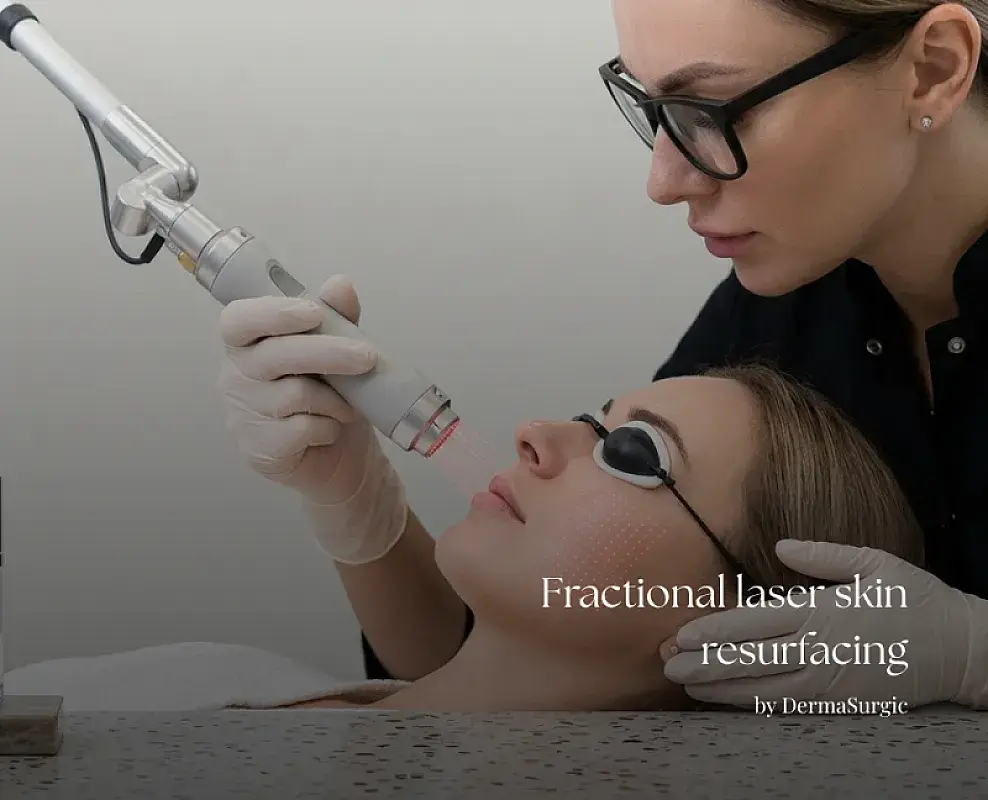
The name of the procedure, "fractional," indicates its primary method of action: the skin is treated in fractions rather than continuously. A specialized laser handpiece distributes the energy beam into thousands of microscopic columns penetrating the dermis, the deep layer of the skin. Each column forms a microscopic treatment zone (MTZ) where tissue is precisely damaged by heat.
Crucially, "islands" of healthy, untouched skin remain between these microscopic columns. This fractional approach ensures the procedure's effectiveness and relatively shorter recovery period compared to older-generation lasers, which burned the entire skin surface. Healthy tissues surrounding the MTZ act as a natural reservoir for regeneration: they immediately initiate the healing process by stimulating the migration of new, healthy cells into the damaged areas.
This controlled damage triggers a powerful physiological response: fibroblasts - the cells responsible for collagen and elastin production - are activated. An intensive process of neocollagenesis begins: old, damaged collagen fibers are broken down and replaced with a new, organized, and elastic collagen network. For this reason, fractional resurfacing effectively reduces wrinkles, smooths scars, and improves overall skin texture and firmness.
Procedure Types: Ablative vs. Non-Ablative Methods
In clinical practice in Lithuania, two main types of fractional lasers are used, differing fundamentally in impact and recovery time:
Ablative Fractional Lasers (e.g., CO2 or Er:YAG): Act most intensively. The energy emitted heats and instantly vaporizes (ablates) tissue within the micro-treatment zones. This method penetrates deepest and causes the most pronounced skin restructuring, remaining the "gold standard" for treating deep wrinkles, severe post-acne atrophic scars, or surgical scars. However, this intensity requires a longer, more complex recovery period: patients can expect pronounced redness, swelling, and scabbing lasting 7 to 14 days, during which special care and social downtime are required.
Non-Ablative Fractional Lasers (e.g., diode or thulium lasers of specific wavelengths): Act more gently. They heat the dermis and stimulate collagen without damaging the epidermis, the top layer of skin. Because the skin surface remains intact, downtime is much shorter: redness and minor swelling usually subside within 1–3 days. This method is ideal for milder issues: early fine lines, pigment spots, enlarged pores, or uneven skin texture. However, to achieve results comparable to ablative lasers, a longer course of 3–5 sessions is required. In Lithuania, depending on patient needs and clinical situations, advanced clinics - such as Dermasurgic - frequently combine different laser technologies for optimal outcomes.
Which Concerns Does the Procedure Best Address?
Fractional skin resurfacing is a medical procedure targeting specific dermatological conditions that are often difficult to correct with other methods. It is most effective for:
Various Types of Scars: One of the primary indications. The laser is effective for treating atrophic (depressed) scars left by severe acne, while also improving hypertrophic (raised) and surgical scars by softening and blending them with surrounding skin.
Signs of Aging: Reduces fine to medium-depth wrinkles, particularly around the eyes ("crow's feet") and lips (perioral lines).
Changes in Skin Texture and Tone: Restores elasticity, tightens enlarged pores, and smooths overall skin relief.
Pigmentation Disorders: Helps reduce sun-damage spots (lentigines) and uneven skin tone.
A Specialist’s Perspective: Expectations vs. Reality
Fractional resurfacing is a long-term process requiring patience. Although initial healing occurs within days or weeks, the final result - collagen restructuring - continues to develop over 3 to 6 months post-procedure.
Dermatologist Rūta from the Dermasurgic clinic emphasizes realistic expectations: "Patients often expect a miracle after a single session, but fractional resurfacing is a process. Our goal is not to create an artificial face, but to safely stimulate the skin's natural regenerative capacity. An open consultation is vital to evaluate skin condition, lifestyle, and realistic expectations."
She adds that patients in Lithuania sometimes underestimate the procedure's seriousness. As a medical intervention, it must only be performed by a qualified, licensed dermatologist or plastic surgeon using certified equipment.
Recovery Period and Lithuanian Climate Features
Seasonality plays a critical role when planning fractional skin resurfacing. The procedure renders the skin highly sensitive to ultraviolet (UV) radiation. Consequently, in Lithuania, these treatments are performed strictly during the darker months, late autumn through winter (typically October to March), when solar activity is at its lowest.
Post-procedure skin (especially after ablative treatments) will be red, swollen, and warm. Patients must strictly adhere to the physician's post-care regimen during the first few days, applying soothing, hydrating, and regenerative ointments, and occasionally topical antibiotics to prevent infection.
Absolute sun protection is the single most critical aspect of post-procedure care. Even on overcast winter days in Lithuania, using a broad-spectrum sunscreen with SPF 50+ is mandatory. Neglecting this rule risks post-inflammatory hyperpigmentation - dark, persistent spots appearing on renewing skin.
Potential Risks and Long-Term Results
While fractional laser technology is considered safe, risks exist. Aside from hyperpigmentation, rare complications include infection (especially if hygiene guidelines are ignored), prolonged redness, or scarring. Risks increase significantly if the procedure is performed by non-medical personnel or if the patient fails to disclose medical history (such as a tendency for herpes simplex flare-ups or active medication use).
Properly performed procedures paired with disciplined patient care yield long-term results. Improved skin quality, smoothed scars, and reduced wrinkles can last for several years. Because lasers do not stop natural aging, maintenance treatments may be required in the future. Fractional skin resurfacing is a serious investment in skin health that requires financial resources, time, and strict adherence to post-care protocols. It is a powerful tool in modern dermatology, but its success relies on realistic expectations and close collaboration between doctor and patient.